A frozen pipe: what bursts, how to prevent it and how to thaw it
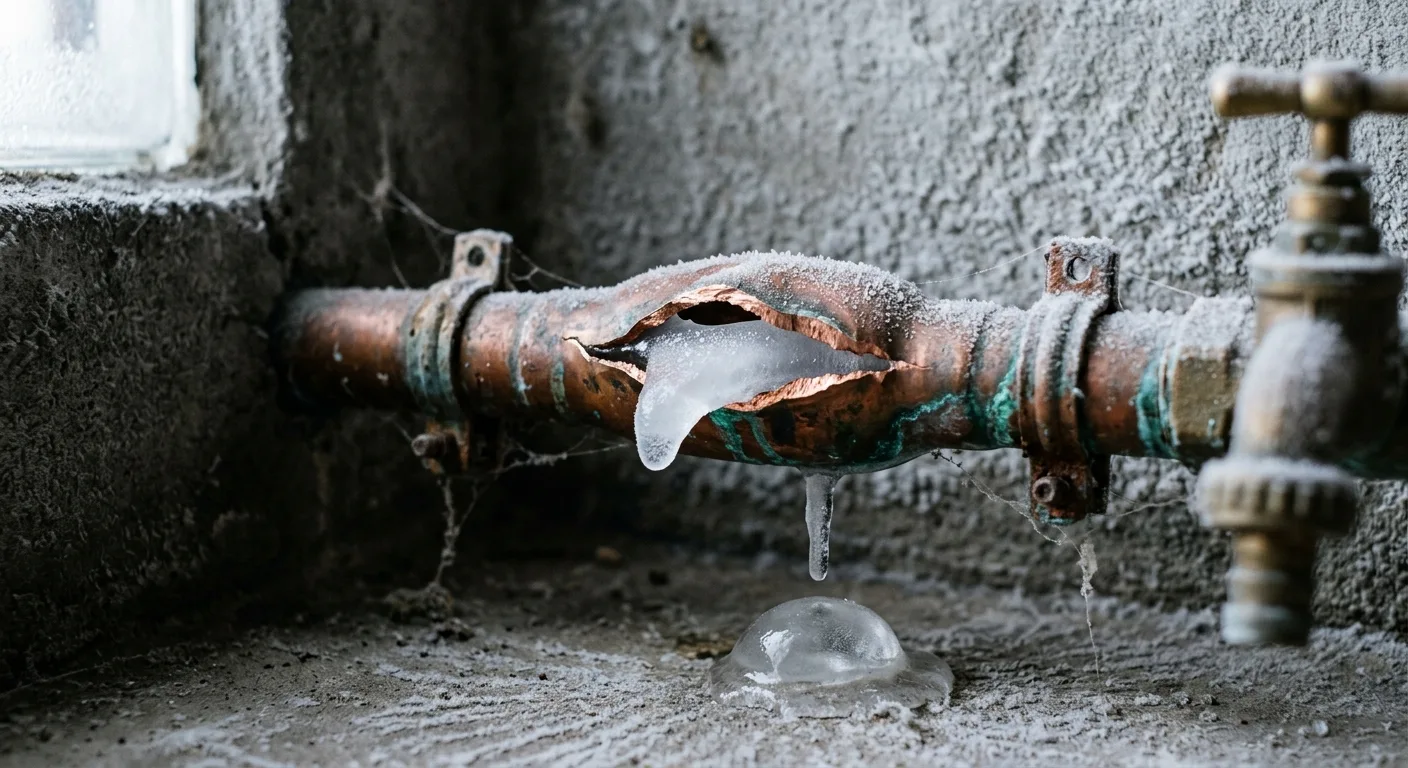
What bursts first
| Material | Behaviour in frost | Risk |
|---|---|---|
| Steel | no give | splits along the seam or a thread |
| Copper | almost no give | splits along a straight run |
| PP-R | some give | usually takes out a fitting rather than the pipe |
| Multilayer | limited give | fails at a compression joint or a kink |
| PEX | most give of the group | often survives one freeze without splitting |
“It survived a freeze” isn't the same as “it's fine”: micro-cracks show up later, usually under pressure and at a bad moment.
Preventing it
Frost depth varies enormously by region — look up the figure for yours.
- Bury a supply line below your local frost depth with at least half a metre to spare, measured to the bottom of the pipe.
- Insulation doesn't heat anything: it only slows cooling. Sections you can't bury deeper need heating cable.
- Run heating cable along the pipe or spiral it, with insulation over the top. Self-regulating cable is safer — it won't overheat plastic.
- Leaving for the winter? Drain the water supply and leave taps open: an empty pipe can't burst. The supply, though — not the heating: an empty heating system corrodes faster, and if it runs on antifreeze there's nothing to drain it for.
- Drain the water heater separately through its own port: it won't empty through the distribution taps.
- Pour antifreeze into the traps — they hold water too, and they split just as readily as pipes.
- The usual trouble spots: where the pipe passes the foundation, unheated cellars, lofts and the stretch under a porch.
Thawing safely
- Open the nearest tap first: meltwater needs somewhere to go, or pressure starts building again.
- Work from the tap towards the plug, never the other way — otherwise meltwater ends up trapped between two ice plugs.
- Warm plastic with a hairdryer, warm air or cloths soaked in hot water. Metal tolerates faster heating, but open flame near plastic or seals is never acceptable.
- Buried sections are thawed by feeding hot water down a thin tube. Electrical thawing works only if the run is steel end to end: a plastic insert, a meter or a dielectric union makes it dangerous. Either way, it's a job for a specialist.
Dangerous internet advice
Common questions
Why does freezing burst a pipe?
Water expands about 9 % as it freezes, and the pipe splits not at the ice plug but where water is trapped between the plug and a closed tap (or a second plug) and the pressure exceeds the wall strength. PEX survives this best; steel and copper worst, because they barely stretch.
How do I thaw a frozen pipe correctly?
Open the nearest tap first so the meltwater has somewhere to go, and heat from the tap towards the plug, never the other way. Plastic takes gentle heat only — a hair dryer, warm air or a cloth soaked in hot water. A blowtorch melts the wall from the inside before the ice gives way.
The pipe survived the frost — can I forget about it?
No. Test the section at working pressure and inspect the fittings: micro-cracks and splits at compression joints show up later, usually under pressure and at the worst moment.