What pressure is normal and what to do about it
What counts as normal
| Pressure | How it shows | What to do |
|---|---|---|
| below 1.5 bar | weak flow: appliances and a tankless heater still fire, but a shower plus two open taps is too much | check the strainer and aerators first, then think about a booster pump |
| 2–4 bar | the working range for household equipment | nothing |
| 5–6 bar | louder water hammer, taps start weeping | fit a pressure reducing valve |
| above 6 bar | hoses wear out fast, as do diaphragms in the heater, expansion vessel and the PRV itself | a PRV is mandatory |
Washing machines and dishwashers are rated to 8–10 bar, water heaters to 6–8 (their relief valve is set to 6–7), flexible hoses to 10 bar working pressure. They hold that steadily — what kills them is water hammer, which multiplies the peak when static pressure is already high.
How to measure it
- Easiest is a gauge with a hose nut — it screws onto a washing machine outlet or a garden tap.
- Measure with taps closed (static) and with one open (dynamic): a drop of more than 1–1.5 bar means a clogged strainer, aerator or a narrowed section — go and find it.
- Check at the evening peak and again at night: the spread tells you how much your neighbours affect it.
- No gauge? A 10-litre bucket filled from the kitchen tap in about a minute is normal flow.
Where the PRV sits in the inlet assembly
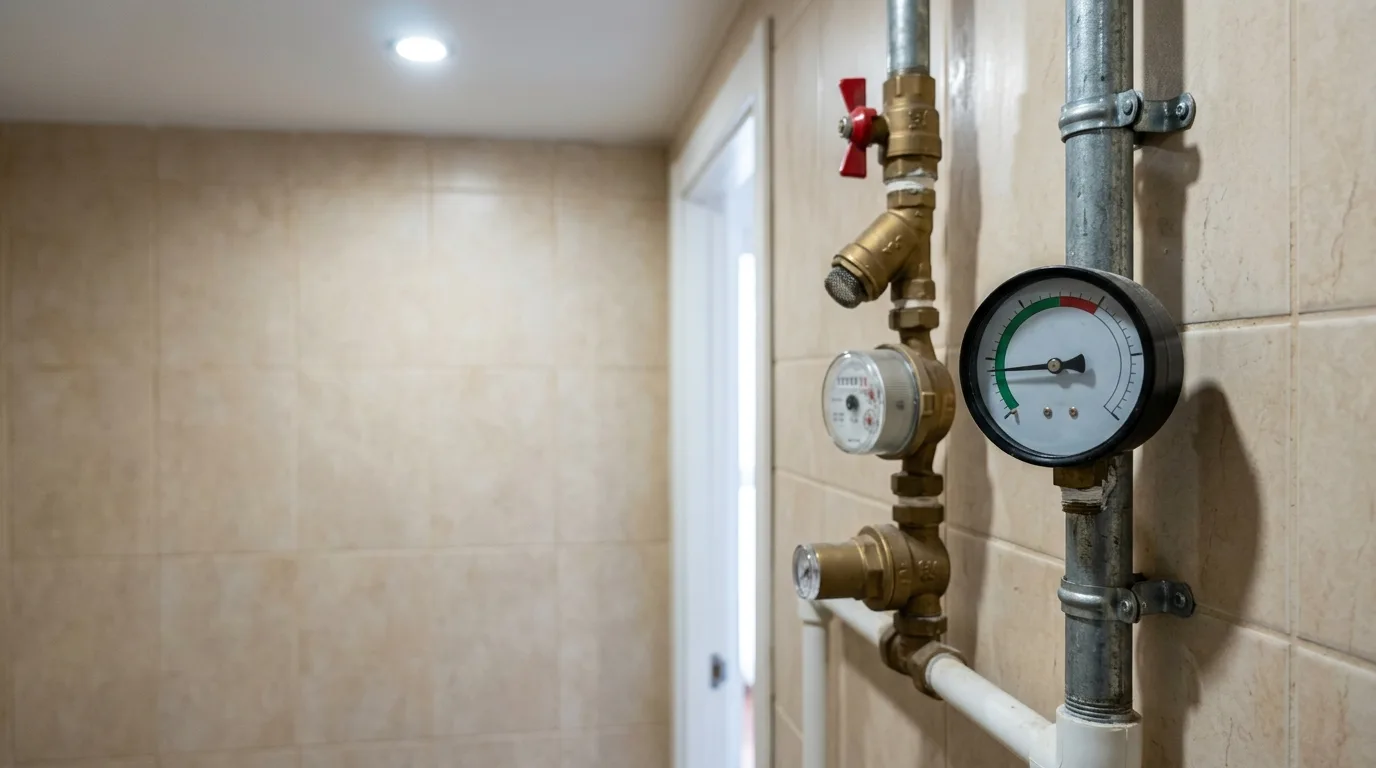
The PRV comes last in the inlet chain: after the valve, strainer, meter and check valve, before the line branches out to the fixtures. A strainer upstream is mandatory (a grain of grit in the seat ruins the regulation), and the gauge goes downstream, so you can see what the PRV is set to. The inlet assembly itself, and why each part is there, has its own page.
The pressure reducing valve
A PRV drops incoming pressure to a set value and holds it steady regardless of spikes in the main.
Typical setting is 3–3.5 bar for a flat. The factory setting is static — taken at zero flow; once water is running, the pressure downstream sags. That is why you set it with the taps closed: turn the screw, briefly crack a tap to bleed, then read where the pressure settles on the gauge downstream of the valve. Set it against a running tap and the static pressure will creep above your target.
- Necessary if the riser runs above 5 bar or swings through the day.
- Fit it strictly in the direction of the arrow on the body.
- It needs a strainer upstream — one grain of grit in the seat undoes the regulation.
Commonly confused
Common questions
What water pressure counts as normal?
The working range is 2–4 bar. Below 1.5 bar the flow is weak, though appliances still start; from 5 bar water hammer gets louder and taps begin to weep — you need a PRV; above 6 bar it is mandatory: hoses and diaphragms wear out fast.
How do I measure the pressure at home?
With a pressure gauge on a hose nut — it screws onto the washing machine outlet or a garden tap. Measure with all taps closed and then with one open: a drop of more than 1–1.5 bar means a clogged strainer, aerator or a restricted section — go and find it.
Does everyone need a pressure reducer?
No. At a steady 3 bar it improves nothing and adds one more thing to service. Fit one on the strength of a measurement — above 5 bar, or if pressure swings through the day. A strainer in front of it is mandatory: one grain of sand on the seat ruins the setting.