How many millimetres is a pipe thread
BSP thread size table
Household plumbing across Europe and most of the world outside North America uses BSP pipe thread: parallel G on fittings and valves, tapered R on the ends of steel pipe — their outer diameters are the same, so there is one table. Measure the outer diameter of a male thread with a caliper and find the row:
| Thread | Outer Ø, mm | Threads per inch | Pitch, mm |
|---|---|---|---|
| 1/4″ | 13.2 | 19 | 1.337 |
| 3/8″ | 16.7 | 19 | 1.337 |
| 1/2″ | 21.0 | 14 | 1.814 |
| 3/4″ | 26.4 | 14 | 1.814 |
| 1″ | 33.2 | 11 | 2.309 |
| 1 1/4″ | 41.9 | 11 | 2.309 |
| 1 1/2″ | 47.8 | 11 | 2.309 |
| 2″ | 59.6 | 11 | 2.309 |
Diameters are for the male (external) thread, measured across the crests. A female thread of the same size measures roughly 2–3 mm less across the inside: 1/2″ → ≈18.6 mm, 3/4″ → ≈24.1 mm, 1″ → ≈30.3 mm.
Thread sizes to scale
The same threads, drawn as rings in true proportion. Once you've seen them side by side, a 1/2″ stops looking anything like a 3/4″ — even from across the store:
Outer diameter of the male thread, mm. Proportions are true to life.
How to measure a thread
The same 1/2″ thread measured three ways. Only the left one is right — across the crests, near the end of the part.
- Male thread: caliper across the outside, crest to crest, then find the nearest row in the table above.
- Female thread: measure the inside diameter and add 2–3 mm before matching against the table (18.6 → 1/2″, 24.1 → 3/4″, 30.3 → 1″) — or simply try a fitting of a known size.
- Count the threads: mark 25.4 mm (1″) along the thread and count the crests. 14 crests → 1/2″ or 3/4″; 11 → 1″ and up.
- In doubt between two sizes? Take the bigger one: worn crests measure under nominal, never over.
Where people get the size wrong
Four slips that send you home with the wrong size. Each has a one-step check:
Male and female
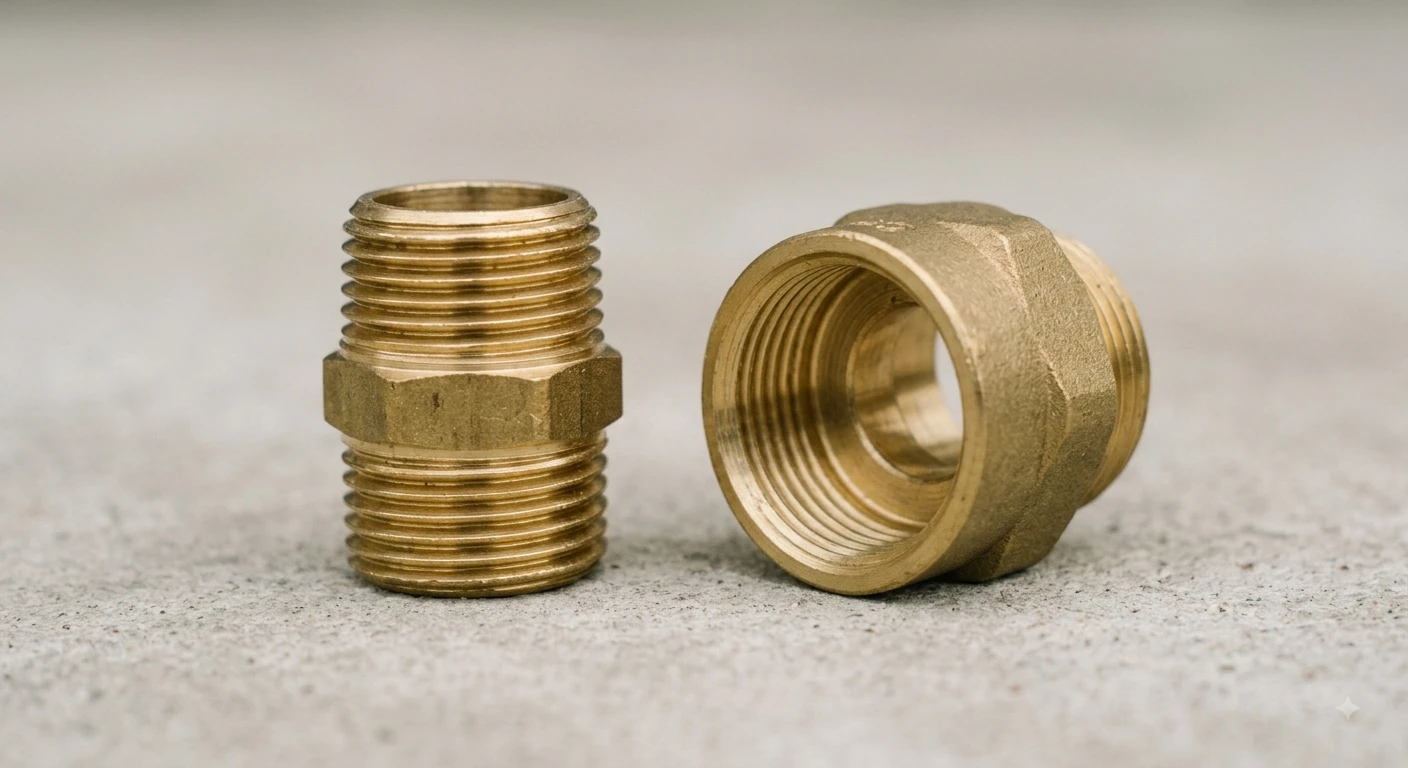
Male (external) thread is cut on the outside of the part; female (internal) — inside it. A joint is always one of each — male into female. In catalogues and on this site male is marked M, female F: a “ball valve 1″ F/F” has internal thread on both ends, a “nipple 1″ M/M” — external on both.
This is exactly the check our builder runs: it won't join two male ends without a coupling between them, and it won't force a 3/4″ thread into a 1/2″.
Price tags, catalogues and the parts themselves name the same two threads differently. These aren't different types — just different words:
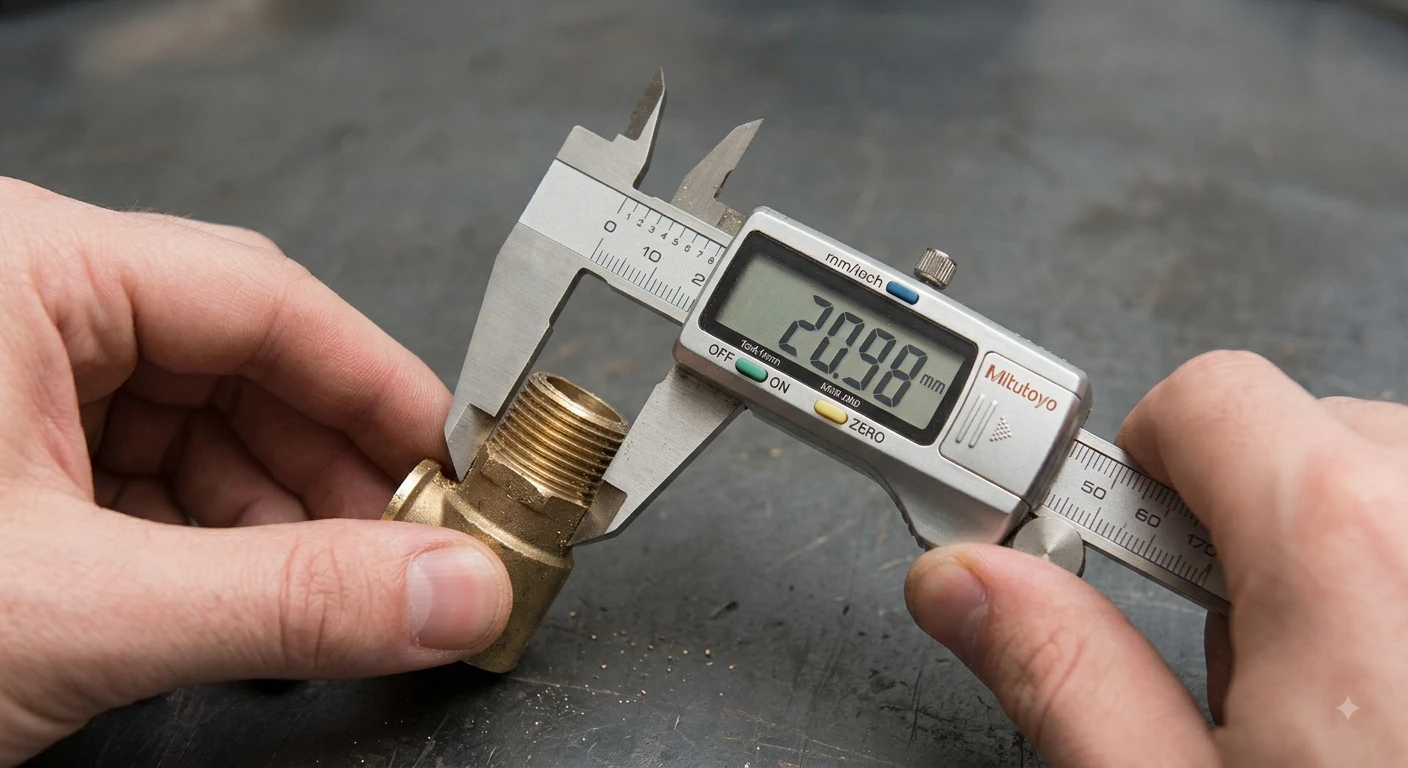
A caliper measures the male thread across the crests: 21 mm → 1/2″. Male always screws into female.
| Thread outside — “male” | Thread inside — “female” |
|---|---|
| M / MT | F / FT |
| external, outer | internal, inner |
| BSP-M, R (tapered) | BSP-F, Rp |
| AG (German Außengewinde) — on European fittings | IG (German Innengewinde) |
Every row is the same pair. “Valve 1/2 F/M”, “1/2″ female × male” and “male-to-female half-inch” are one part under different names.
Parallel and tapered
Household fittings mostly carry parallel thread (G): it doesn't seal by itself, so the joint is sealed with PTFE tape, flax or anaerobic sealant on the male thread.
Tapered thread (R) tightens into the seal: the profile clamps metal on metal, but sealant still goes on — it fills the residual gap along the crests. You'll meet it on steel pipe ends and some valves. A tapered male will screw into a parallel female — that pairing is standard and tight.
The dashed line follows the crests: level on the left, converging on the right. That difference is why they seal differently.
Look-alike threads that don't fit
The expensive mistake isn't mixing up 1/2″ and 3/4″ — you can see that. It's picking a thread from another system at almost the same diameter. It starts for a turn or two, then leaks or strips:
| Thread | Where you meet it | Mistaken for |
|---|---|---|
| M24×1.5 (“24×19”) | some Italian manifolds and radiator valves; not compatible with the 3/4″ eurocone | almost 3/4″ (24 vs 26.4) |
| M22×1 | tap aerators, some shower hoses | 1/2″ (21 vs 22) |
| NPT (American) | imported compressors and US-market equipment | 1/2″ NPT has the same 14 TPI, but a 60° profile instead of 55°: two turns and it jams; at 1″ the pitch differs too |
| 3/4″ garden hose (GHT) | garden hose connectors | called “3/4”, but it isn't BSP G3/4 |
Brass is the pipe thread, the dashed ring is metric. At 1:1 you can't tell them apart by eye — and they don't work together.
One tell for a foreign thread: it spins in easily, then stops dead. A matching thread runs its first two or three turns smoothly and without effort.
What to seal the thread with
Four working options — PTFE tape, flax with paste, anaerobic gel and sealing cord. In short: PTFE for clean factory threads you won't need to reposition; flax or cord when a valve or gauge has to end up facing the right way; anaerobic for metal joints you'll never take apart. The full comparison, wrap direction and typical mistakes live on their own page — we don't repeat them here.
Whatever you pick, sealant goes on the male thread only — and never on a union's flat gasket.
Stripped thread: what now
A stripped thread is one whose crests are crushed so the part no longer holds: it spins past the stop or weeps however hard you tighten. Recovering it in place almost never works, so the question is only what to replace.
| Where it stripped | What you can do |
|---|---|
| On a fitting or valve | replace the part — cheaper than any attempt to save it |
| On the end of a steel pipe | cut the section back and cut a new thread with a die, or weld on a threaded nipple |
| Inside a female brass thread | run a tap through if one or two crests are damaged; beyond that, replacement |
| On pipe inside a wall | it can't be extended: open the chase and fit a new piece with a fitting |
- The die and tap must be pipe-thread (BSP), not metric: metric tooling of the same nominal size will finish the thread off for good.
- Cut threads with a die of the same size, always with cutting oil and a lead-in chamfer on the pipe end.
- Cut only the length that will actually enter the part: extra threads hold nothing and only weaken the wall.
- Deburr and blow the pipe out afterwards: swarf left inside travels to the tap and blocks the aerator.
- Resist the urge to “wrap more PTFE on a stripped thread” — that's a leak next week, not a repair.
Field tips
Short rules that save a trip to the store and a joint you'd otherwise redo.
Common questions
How many millimetres is a 1/2 inch thread?
The outside diameter of a 1/2″ male thread is about 21 mm, not 12.7. The inch in the name comes from the nominal bore of old steel pipe and does not describe the thread itself. Next sizes: 3/4″ is 26.4 mm, 1″ is 33.2 mm.
How do I tell a male thread from a female one?
A male thread is cut on the outside of the part, a female one on the inside. A joint is always male into female. Catalogues write the same pair as M/F or, on German fittings, AG/IG — different words, not different thread types.
What do I do with a stripped thread?
On a fitting or a valve, replace the part — it costs less than any attempt to save it. On the end of a steel pipe, cut the section off and cut a new thread with a BSP die, or weld on a threaded nipple. Piling more PTFE tape onto crushed threads buys you a week, not a repair.