Banging pipes: water hammer
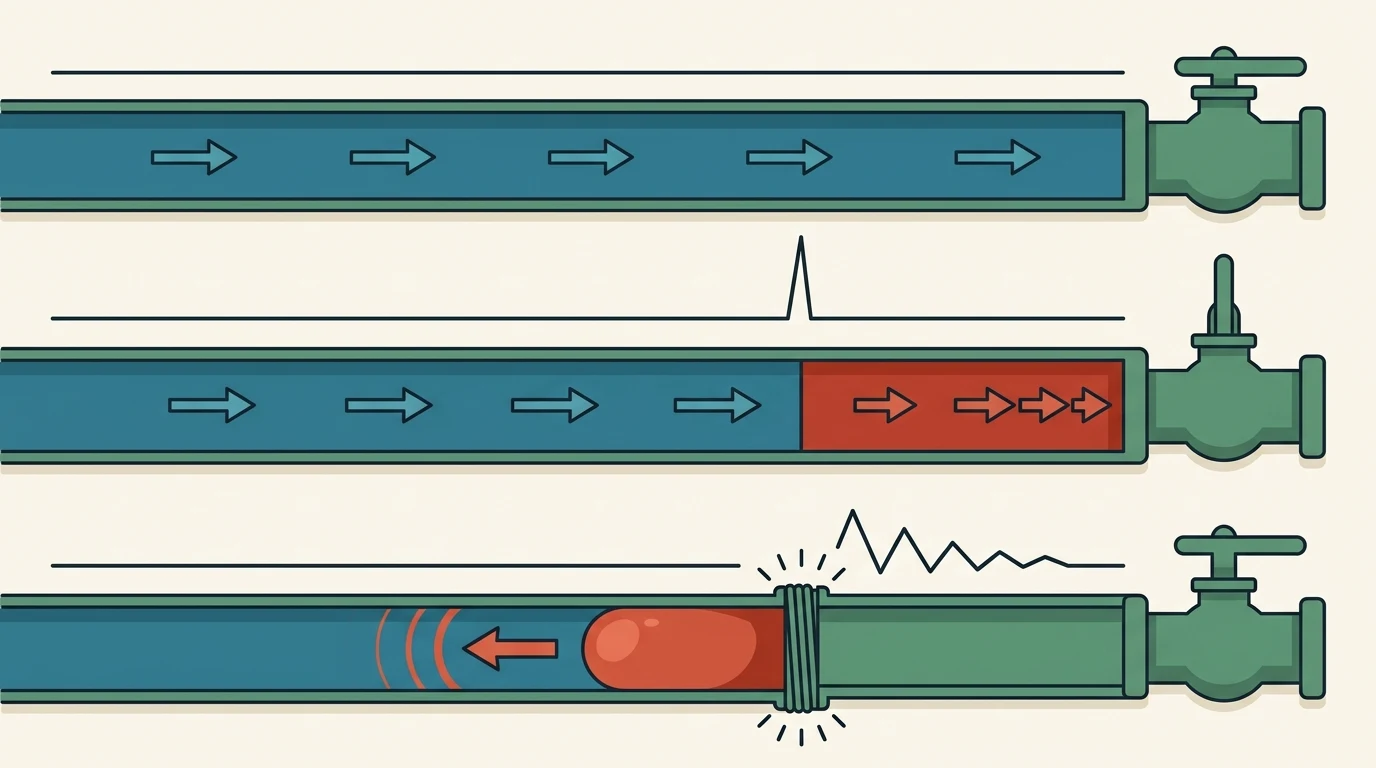
Where the hammer comes from
Water in a pipe is a moving mass. When a valve cuts the flow instantly it does not slow down, it slams: a wave of raised pressure runs along the pipe, reflects and comes back. You hear it as a bang or a run of clicks.
So the culprit is usually not old pipework but fast valves: the solenoids in washing machines and dishwashers close in tens of milliseconds, and a single-lever mixer nearly as fast. A screw-down tap, which closes gradually, produces no hammer at all.
- The longer the straight run up to the valve, the more noticeable the hit: on a long pipe even a fairly slow closure counts as “instant”, and the wave comes through at full strength.
- The higher the pressure and velocity, the harder still: a narrow pipe at a high flow hits harder than a wide one.
- Rigid materials carry it better: steel and copper bang more audibly than plastic, which damps part of the wave.
Where it ends up
One bang breaks nothing. Repetition breaks things: every wash cycle is several hammers, and over the years they find whatever is weakest.
- Threaded joints working loose, and damp where it was dry yesterday.
- A cracked filter housing — the classic outcome for a plastic bowl on a rigid line.
- Weeping around the meter body and a pressure reducer drifting off its setting.
- Broken clips, pipes rubbing against them, and eventually a pipe wall worn thin.
If the banging is new, the building has not settled. Something changed: a new appliance, higher pressure in the main, or a clip that came loose.
What helps and what does not
The order is the same as in any diagnosis: measure first, buy second. Half of what is sold against water hammer treats the wrong cause.
What to do, in order
Find the source: start the washing machine and listen for whether the bang lines up with it filling. If it does, you have your source — the rest is about dealing with it.
Measure the pressure with a gauge at any draw-off point — the closer to the inlet, the better. Above 5 bar you need a reducer, and it goes at the inlet, not at the appliance.
Fit a water hammer arrestor right at the offending appliance — on the hose of the washing machine or dishwasher.
Check the clips along the run: sagging stretches and unsupported bends make both the noise and the movement worse.
If it only bangs when the mixer closes and the pressure is normal, closing it a touch slower is sometimes enough — and on a long rigid branch an arrestor at the mixer does the rest.
Common questions
Why do the pipes bang when I close a tap?
It is water hammer: the flow stops almost instantly and the energy of the moving water becomes a spike of pressure. The worst offenders are fast valves — the solenoids in washing machines and dishwashers, and single-lever mixers.
Is water hammer dangerous for the pipework?
One event is not. Regular hammer is, because it accumulates: threaded joints work loose, filter bowls crack, meters start weeping and clips break. What fails is the weakest point, not the pipe as a whole.
Do water hammer arrestors work?
Yes, when fitted next to the source — on the hose to the appliance or at the mixer. Fitted at the inlet it damps the wave only after it has crossed the whole flat, which is of little use.
Can high pressure be the cause?
It can, and it is the first thing to check with a gauge. Above 5 bar the hammer is noticeably harder, and the right answer is a reducer at the inlet with a gauge after it.
Why does it only bang at night?
Pressure in the main is usually higher at night, when the building draws less water. The same valve gives a harder hit, and the quiet makes it easier to hear.