How household plumbing is put together around the world
Five worlds, sorted by the tool
Every country's plumbing aisle answers one question first: what does a person hold in their hands to make a joint. That answer sorts the whole world into five groups, and almost everything else — pipe material, size range, thread standard, even whether a house has hot-water pipes at all — follows from it.
The colour of each world runs through the rest of this page: the same five colours mark the columns of the matrix, the region cards and the share bars below.
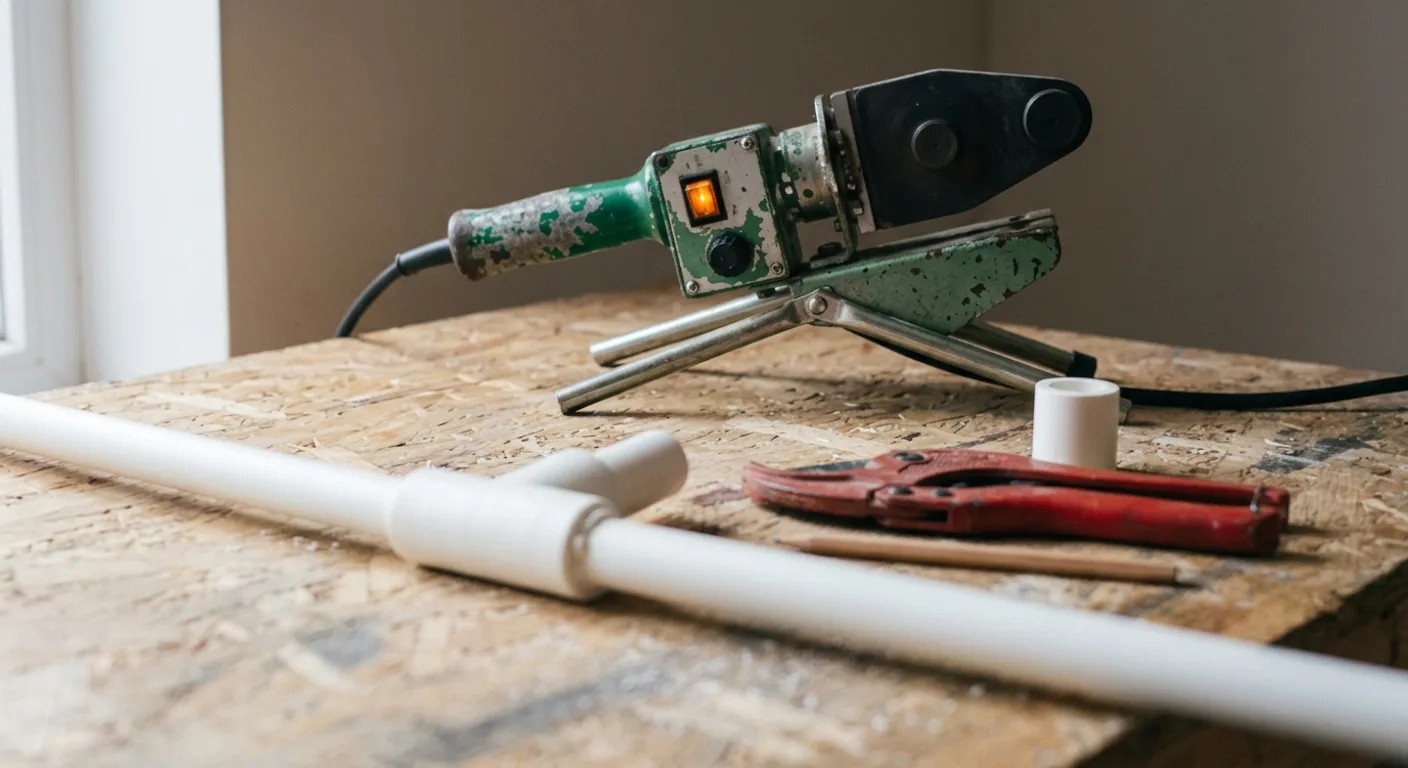
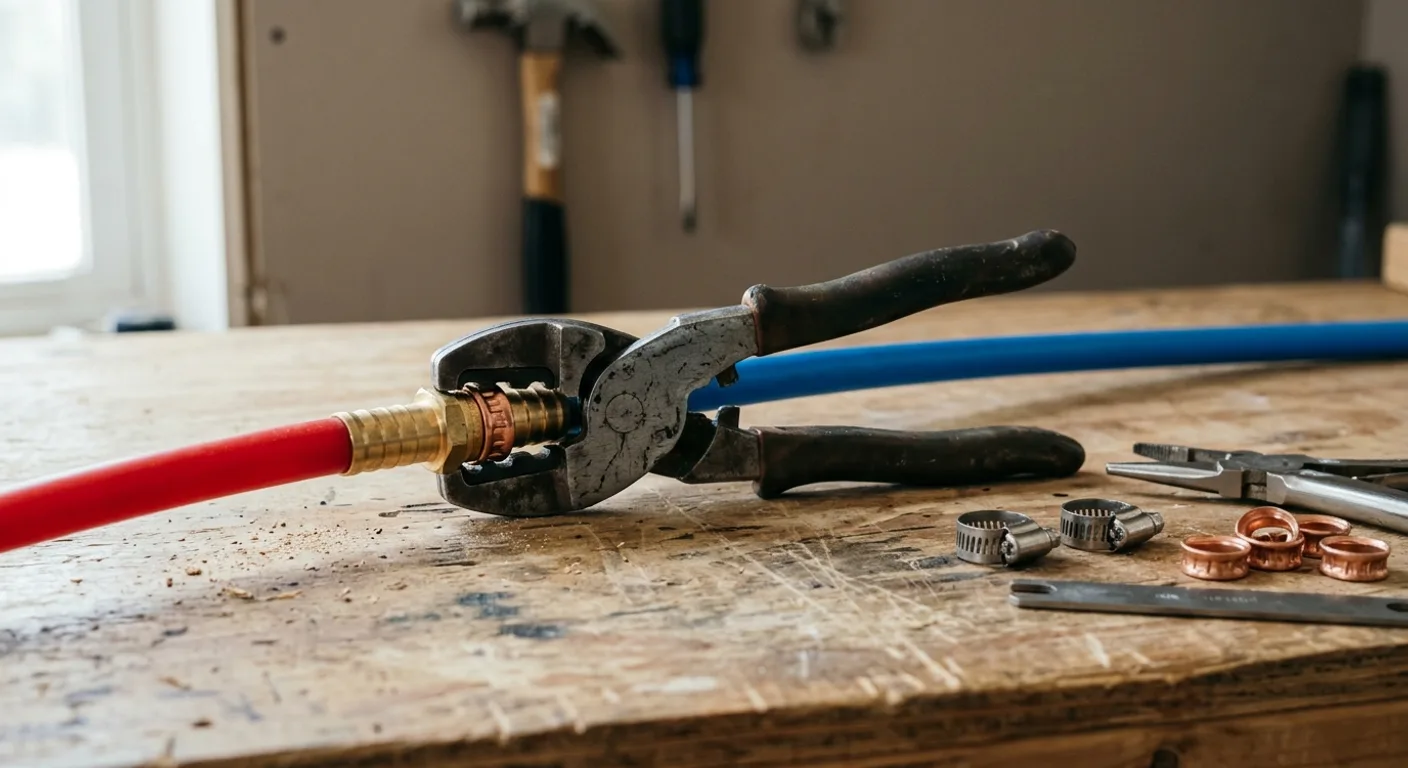
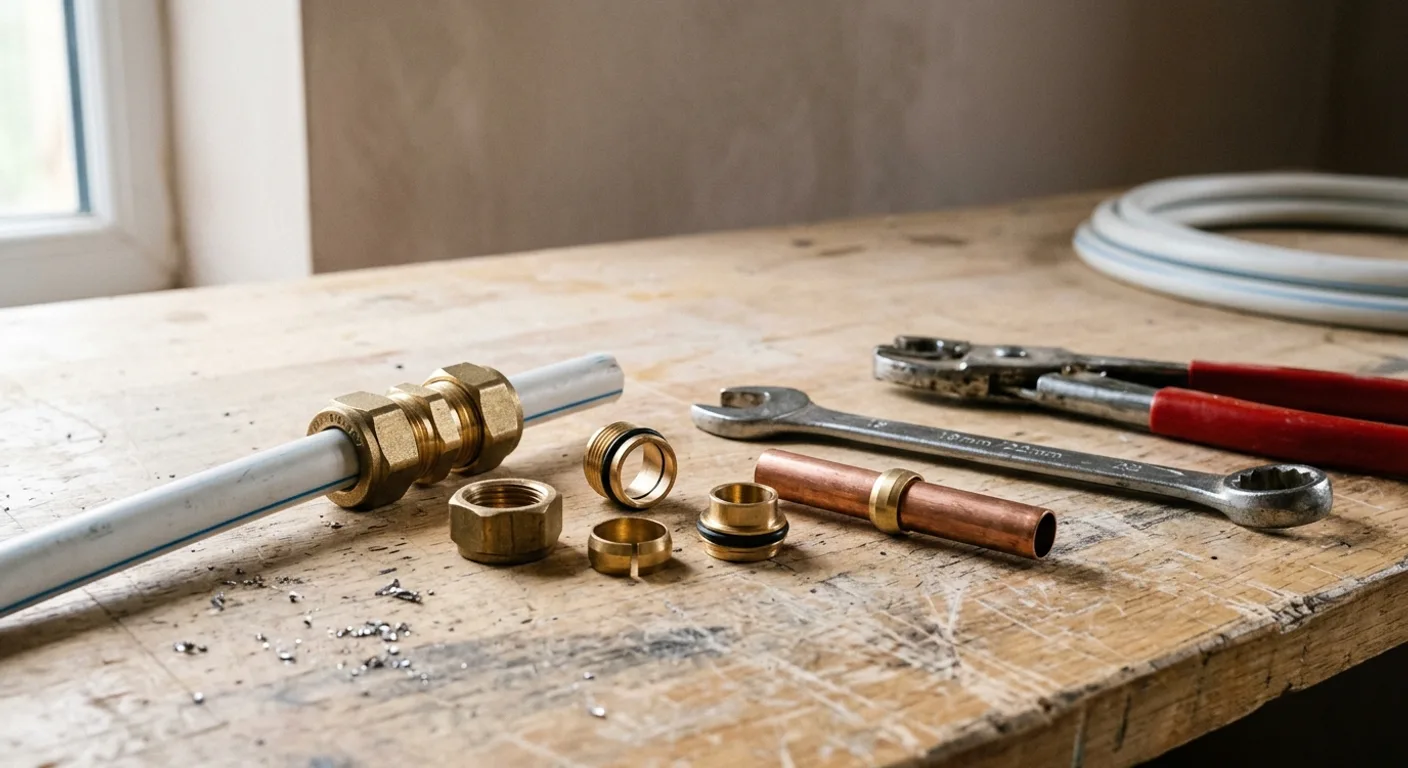
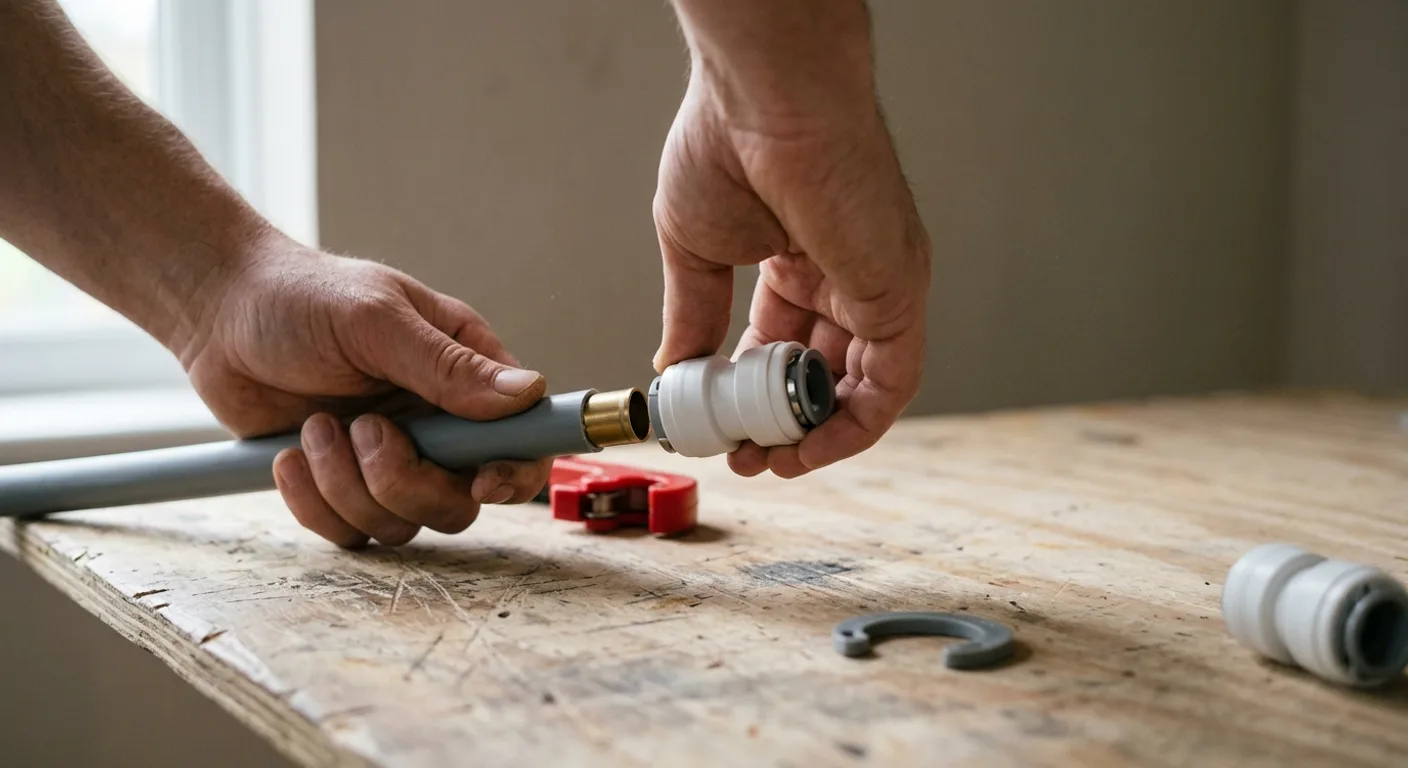
The tool decides the material, not the other way round.
Confidence marks used below: ● checked against a named source · ◐ inferred from retail ranges and trade press · ○ general knowledge. The country groupings on this page are ◐ — the reason is in the last section.
Why that tool and not another
A socket welder costs between ten and sixty dollars anywhere it is sold, and it is the whole kit: no consumable rings, no calibrated jaws, no hire deposit. A cordless press gun costs up to three thousand. That gap, not any property of the plastic, is why PP-R fills the shelves from Warsaw to Guangzhou and why a German homeowner reaches for a compression fitting instead of the press their plumber owns.
Push-fit sits at zero: the only tool is a pipe cutter. It is no accident that the two countries where a homeowner needs no tool at all are also the two where the aisle is full of it.
Entry price of the tool, logarithmic scale. What it costs on local shelves is listed below.
- Socket welder: ₴450–1 000 · 150–300 PLN · 289–313 lei · 800–1 500 TL · 1 000–2 500 Kč · 15–40 thousand Ft · €40–110 · 1 815 MXN · Rs 3 000–3 400.
- Crimp and cinch: Apollo cinch $49.98 · crimp tool $56 · hand expander $79 · cordless M12 expander $499–599 · press $4 199.
- Press and compression: hand press pliers €149–240 · cordless press €1 500–3 000 · pince à sertir €100, hire €15–40 a day.
- Push-fit: pipe cutter £6–15 · press tool £900–1 600, or hire at £40–60 a day.
- Solvent cement: a tin and a hacksaw · CPVC cutter ₹150–600.
Nine pipes, eleven ways of joining them
The combinations that exist in practice are far fewer than the grid allows. PP-R is welded and nothing else. Galvanised steel is threaded and nothing else. Copper is the only material with four live methods at once, which is why it survives in countries that have moved on from it everywhere else.
◐ How solid a cell is reflects how common the pairing is on the shelf, not whether a standard permits it.
Two parts sit outside the grid and join any world to any other: the brass threaded adapter and the braided flexible hose in ½″ and ⅜″. Every crossing between two systems on this page runs through one of them.
“Half an inch” is eight different pipes
Half an inch is a name, not a measurement. It came from the bore of Victorian steel pipe and stayed attached to whatever replaced that pipe locally, so the same two words now sit on products whose outside diameters differ by eight and a half millimetres — enough that almost no two of them will take the same fitting.
Drawn to scale, the spread is obvious. The steel end of the range is half again as wide as the Australian one:
Outside diameter in millimetres, true proportions. All eight are called half an inch where they are sold.
Measure your pipe and find the row
This table is read from your pipe, not from the top. Measure the outside diameter with a caliper, find the nearest row, and it tells you which system you are holding and what the shelf label will call it.
It also shows why a fitting bought abroad refuses to go on. Between 15 and 21 mm sit products labelled half-inch and products labelled three-quarter, from different systems, interleaved — the label on the box tells you nothing until you know which system it belongs to.
| Outside Ø, mm | System | Where | Sold as |
|---|---|---|---|
| 12.7 | Copper DN15 | Australia, Chile | ½″ |
| 14 | Copper 12/14 | France | ½″ |
| 15 | Copper EN 1057 | UK, Netherlands, Spain, Poland | ½″ |
| 15.9 | Copper, PEX, CPVC — CTS | US, Canada, Mexico, India | ½″ |
| 16 | Multilayer | Western Europe, CIS | ½″ |
| 16 | PEX | Europe | ½″ |
| 17 | Pipe 13A | Japan, Korea | ½″ |
| 19.05 | Copper DN20 | Australia, Chile | ¾″ |
| 20 | PP-R | Southern and Eastern Europe, Turkey, CIS, China | ½″ |
| 20 | Multilayer | Western Europe, CIS | ¾″ |
| 21.3 | Steel IPS, GI | India, Pakistan; legacy everywhere | ½″ |
| 22 | Copper EN 1057 | UK, Netherlands, Spain, Poland | ¾″ |
| 22.2 | Copper, PEX, CPVC — CTS | US, Canada, Mexico, India | ¾″ |
| 25 | PP-R | Southern and Eastern Europe, Turkey, CIS, China | ¾″ |
| 25.4 | Copper DN25 | Australia, Chile | 1″ |
| 26 | Multilayer | Western Europe, CIS | 1″ |
| 26.9 | Steel IPS, GI | India, Pakistan; legacy everywhere | ¾″ |
| 28 | Copper EN 1057 | UK, Netherlands, Spain, Poland | 1″ |
| 28.6 | Copper, PEX, CPVC — CTS | US, Canada, Mexico, India | 1″ |
| 32 | PP-R | Southern and Eastern Europe, Turkey, CIS, China | 1″ |
| 33.7 | Steel IPS, GI | India, Pakistan; legacy everywhere | 1″ |
Ranges left out of the table to keep one value per cell: Scandinavian PEX 15 / 18 / 22 mm, South-East Asian PVC (JIS 22 / 26 / 32, TIS ≈18 / ≈22 / ≈26, PNS 21.3 / 26.9 / 33.7), Japan and Korea 13A / 16A / 20A, Spanish and Portuguese multilayer 25 instead of 26. The same sizes also carry local names: DN across Europe and the CIS, NB in India, 4分 / 6分 / 1寸 in China.
Two thread families
Almost everything threaded in household plumbing belongs to one of two families. BSP covers Europe, the CIS, Turkey, India, Pakistan, Brazil, Argentina, Chile, Australia, New Zealand, the Gulf, China and most of South-East Asia. NPT covers North America, Central America, Venezuela, Colombia, Peru and the Philippines. The Philippines sitting inside a BSP region is the kind of border that catches people out.
What matters is not the name but what holds the water in a given joint — and that is a property of the joint, not of the thread family. A permanent joint seals on the thread: flax and paste, PTFE tape or sealing cord fill the gap between the flanks. That is how both tapered R and parallel G are made up on steel pipe — the riser in a block of flats is held by flax. A demountable joint seals on a washer or a machined face: union, cap nut, flexible hose, meter — there the thread only pulls the parts together, rubber or fibre holds the water, and the joint can be remade as often as you like.
The difference between tapered and parallel lies elsewhere. A tapered thread wedges on its own and so forgives an under-tightened joint, but every remake shaves a little metal, and by the third or fourth time it stops holding. A parallel thread never wedges: it needs either a wrap or a washer, but it does not wear out from being taken apart.
| Standard | Marking | Sealed by | Where |
|---|---|---|---|
| BSP parallel, ISO 228-1 | G (BSPP) | in a demountable joint a washer, an O-ring or a face; in a permanent one flax or PTFE tape on the thread | Europe, the CIS, Turkey, India, Pakistan, Brazil, Argentina, Chile, Australia, New Zealand, the Gulf, China, South-East Asia except the Philippines |
| BSP tapered, EN 10226-1 / ISO 7-1 | R, Rc, Rp | the thread itself — flax and paste, PTFE tape, sealing cord | the same countries, on steel and brass; Japan R/Rc, Korea PT |
| NPT, ASME B1.20.1 | MPT/FPT, MIP/FIP | the thread itself — PTFE tape, paste | United States, Canada, Mexico, Central America, Venezuela, Colombia, Peru, Philippines |
| Metric M | M10×1, aerator M22×1 / M24×1 | a washer | tap tails — Europe, the CIS, Latin America |
| GHT / FHT | ¾″-11.5 NH | a washer | United States and Canada: washing machine, garden tap |
French catalogues write the same BSP threads as two numbers: 12×17 is ⅜″, 15×21 is ½″, 20×27 is ¾″, 26×34 is 1″, 33×42 is 1¼″. It is not a separate standard and not a metric thread.
The trap: G½ and NPT½ screw together and then weep
Half-inch BSP and half-inch NPT share a pitch — fourteen threads per inch on both. So they start by hand and run in as though they belong together: you tighten to the stop, put the appliance under pressure, and find the leak the next day.
What does not match is the flank angle: 55° on BSP against 60° on NPT. The flanks never seat on each other, a spiral channel is left between them, and tape does not close it — tape is made for a gap measured in hundredths of a millimetre, not for a different tooth shape.
The drawing shows parallel G, but BSP comes tapered as well — R on the outside, Rc on the inside, and its taper is the same 1:16 as NPT. It meets an American thread even more readily than the parallel one and weeps for the same reason: 55° against 60° is true of the whole BSP family, not only of G.
A ½″ male thread in section, over one inch of its length. The pitch is identical, so the crests stand in one column. The flank angle is not, so the flanks never seat on each other.
At 1″ and ⅜″ the BSP and NPT pitches differ — 11 against 11.5, and 19 against 18 — and there the two threads honestly refuse each other. The trap lives on exactly the two most common sizes: ½″ and ¾″.
How they do it, region by region
The same five questions asked of eight regions. Read down a column rather than across a card — the differences show up faster that way.
Whether you may touch it yourself
Four positions, and the gap between what the rule says and what the shelves say is widest in the middle two. Germany writes that work past the meter goes through a registered installer, and every builders' merchant sells press fittings to whoever walks in. Australia writes that plumbing is licensed work, and the push-fit fittings on the rack carry a note saying so.
○ Positions as of September 2026. Local rules and building codes override any summary on this page, including this one.
What is already in the walls
Every country carries a layer of pipe that is no longer sold but is still in service, and a couple of systems that a survey flags before anything else. Polybutylene in North America and New Zealand is the sharpest example: it worked, then it did not, and it took a class action with it.
● Dates and case figures from the sources listed at the end. Bands are installation periods, not service life.
| Region | What a renovator meets |
|---|---|
| United States | Galvanised up to 1960; copper Type M, lead solder until 1986; grey polybutylene PB2110 from 1978 to 1995; early CPVC in the south; lead services |
| Canada | Poly-B from 1978 to 1998 — around 148 000 homes in Alberta, and insurers asking for replacement; Kitec from 1995 to 2007, orange and blue |
| United Kingdom | Lead services; imperial copper before 1971, where ½″ is 12.7 mm and needs a stepped olive; polybutylene from the 1980s |
| Germany, Austria | Galvanised up to about 1985; copper from 1970 to 2005; the local rule that copper may only follow galvanised, never precede it |
| France, Italy, Spain | Lead in pre-war stock; galvanised into the 1970s and 1980s; copper from 1960 to 2010 as the main body |
| Post-Soviet countries, Central and Eastern Europe, Turkey | Threaded galvanised and black steel in panel blocks, closing up from the inside on the hot line; replaced with reinforced PP-R flat by flat |
| New Zealand | Dux Qest polybutylene from the 1970s and 1980s, 20 000 to 40 000 homes — the first thing a buyer's survey looks for |
| India, Pakistan, Bangladesh | Galvanised steel in anything over about twenty years old: rusty water in the morning, a bore closing up; new CPVC spliced in through brass adapters |
| Latin America | Galvanised into the 1980s; in Brazil white threaded PVC from 1970 to 1990, before the switch to solvent-welded |
Habits that separate countries more than materials do
Two houses can be piped in the same material and still be nothing alike. What differs is the layout logic — where the joints are allowed to be, and what heats the water.
- Scandinavia: pipe-in-pipe from a manifold cabinet. There are no concealed joints at all — every connection sits in the cabinet, on a tray that shows a leak.
- France: PER in conduit from a nourrice manifold under the screed, with copper wherever the pipework is on show.
- Japan and Korea: a header feeding sheathed flexible pipe, push-fit connections, sizes written 13A, 16A and 20A.
- Germany: copper is left out where the water is soft — below pH 7.4 it is simply not used.
- Mexico, Venezuela, the Dominican Republic, Peru and India: a roof tank, and a whole house sized around 0.2 to 0.5 bar of gravity. A booster pump is its own subject.
- Brazil: an electric shower head instead of a hot-water system, so in most houses there is no second pipe to run.
- Italy and Spain: manifold distribution takes roughly nine joints in ten out of the walls.
- Turkey and China: PN20 hot pipe used on the cold line as well — one pipe on the van, nothing to mix up.
- United States: red and blue PEX is marking only; both reels are the same pipe.
- United Kingdom: a push-fit joint may be buried, and plumbers still leave an access panel over it.
What it is called there
A joint is always male into female, and every language has its own pair of words for it. The catalogue words matter more than they look: an order placed in the wrong one arrives as the wrong part.
| Language | Male | Female | Nipple | Coupling | Union | Reducer |
|---|---|---|---|---|---|---|
| English (US, Canada) | male, MPT / MIP | female, FPT / FIP | nipple | coupling | union | bushing |
| English (UK, Australia) | male iron, MI | female iron, FI | nipple | socket | union | bush |
| German | AG (Außengewinde) | IG (Innengewinde) | Doppelnippel | Muffe | Verschraubung | Reduziernippel |
| French | mâle, M | femelle, F | mamelon | manchon | raccord union | réduction MF |
| Italian | maschio | femmina | nipplo | manicotto | bocchettone | riduzione |
| Spanish (Spain, Latin America) | macho | hembra | niple, machón | manguito, cople | unión, enlace | reducción |
| Portuguese (Brazil) | macho | fêmea | niple | luva | união | bucha de redução |
| Polish | GZ | GW | nypel | mufa | śrubunek | redukcja |
| Czech | vnější závit | vnitřní závit | vsuvka | nátrubek | šroubení | redukce |
| Hungarian | KM | BM | kettős karmantyú | karmantyú | hollandi | szűkítő |
| Romanian | FE | FI | niplu | mufă | olandez | reducție |
| Turkish | dış diş | iç diş | nipel | manşon | rakor | redüksiyon |
| Ukrainian and post-Soviet catalogues | ЗР, НР | ВР | ниппель, бочонок | муфта | американка | футорка |
| English (India, Pakistan) | male, MTA | female, FTA | hex nipple | socket | union | reducer |
| Chinese | 外丝 | 内丝 | 双外丝 | 直接 | 活接 | 内外丝 |
Two false friends worth knowing. Rosca gas in Spain, Argentina and Chile means a BSP thread; in Mexico, Colombia, Peru and Venezuela the same word rosca sits on NPT. And cople in Mexico is manguito in Spain — one part, two words.
Where these numbers come from, and where they do not
Three countries publish figures anyone can check. The United States, Canada and India have survey or industry data on what goes into new housing. Nowhere in Europe, Latin America or the post-Soviet region does — not as a share by material, not from a trade body, not from a regulator.
So the rest of this page is built on retail range width, trade press and forums: how many pipe listings a national retailer carries in each material, and what proportion of the fittings on the shelf belong to one joining method. That is a decent proxy for what people buy and a poor one for what is installed. Where a claim rests on it, it is marked ◐.
The first three and the last are measured shares of households. The two in the middle are shares of a retailer's range, which is a different thing and marked as such.
- United States, the PEX curve: 10% in 1997, 16% in 2002, 63% in 2016, over 70% now, against CPVC under 20% and copper under 10% — Home Innovation Research Labs, HUD PD&R. The driver is priced: copper moved from $0.61 a pound in 2001 to $4.55 in 2025 (Pro Builder).
- India: a ₹500 billion pipe market in FY25 — Supreme 14%, Ashirvad 11%, Astral 8%, Finolex 8%, Prince 5% (ICICI Direct). By material in FY20: UPVC 64–65%, CPVC 15–16%, HDPE 15%, PP-R 4–5% (Equirus).
- Retail ranges counted for this page: Screwfix (UK), Leroy Merlin Italy — 178 threaded multilayer listings against 7 for press, Leroy Merlin Portugal — 215 against 25, Rozetka and Epicentr (Ukraine, 874 PP-R listings against 4 for copper pipe), Hepsiburada (Turkey, 5 617 results for pprc boru), Gorgia (Georgia, 9 pipes in the plumbing category and all of them PP-R), Sodimac (Chile, 218 copper listings, 13 PP-R, 11 pressure PVC, 42 PEX, no CPVC), Home Depot (US, 139 PEX pipe listings, 603 PEX fittings, 40 copper), Praktiker Bulgaria (151 polypropylene of 407), lalafo.kg (Kyrgyzstan, no multilayer listings at all).
- Tool prices were read from national retailers in each country and converted at September 2026 rates; they move with the currency, not with the technology.
◐ Anything on this page about a European, Latin American or post-Soviet country is inference from the sources above, not a measured share. Treat it as a picture of the aisle, not a census of the housing stock.
Common questions
Can two different systems be joined directly?
Almost never. Between any two worlds there is usually a third part — a brass threaded adapter or a braided flexible hose: each takes the pipe the way its own system does, and the two meet on the thread. There is one exception: a push-fit fitting in the CTS range accepts copper, PEX and CPVC of the same size, because it grips the pipe from the outside with a collet ring. But CTS is a North American range, and that fitting will not take European 16 or 20 mm.
Which of the five systems is best?
Put that way the question has no answer, and this page deliberately does not give one. Each world has held its ground for decades where it settled: to its own cost of labour, its own rules on who may work, its own water. PP-R is not “worse” than copper — it took the shelf where the householder does the work, and copper stayed where a trade crew installs it. Comparison makes sense for a specific pair in specific conditions: PP-R against multilayer, copper against PP-R.
Why does my country not stock what I saw in a foreign video?
Two reasons, neither about the quality of the material. First, the entry price of the tool: the shelf follows what most people build with, and most people buy what one tool can handle. Second, who is allowed to work: where pipework is licensed, the consumer range is much thinner, because the shelf's customer is a crew rather than a resident. So a clip from Texas shows PEX being crimped, one from Warsaw a socket welder, and from Melbourne there is likely no clip at all.
Do these borders shift over time?
Materials do, over decades. The United States moved almost entirely off copper onto PEX in thirty years, and the post-Soviet countries and Turkey replaced steel risers with reinforced PP-R over the same span. Thread families and size ranges do not move at all: they are tied to every fitting already installed, and no country can change them without throwing out what is in the walls. The pipe in a country changes; its ½″ stays BSP.